
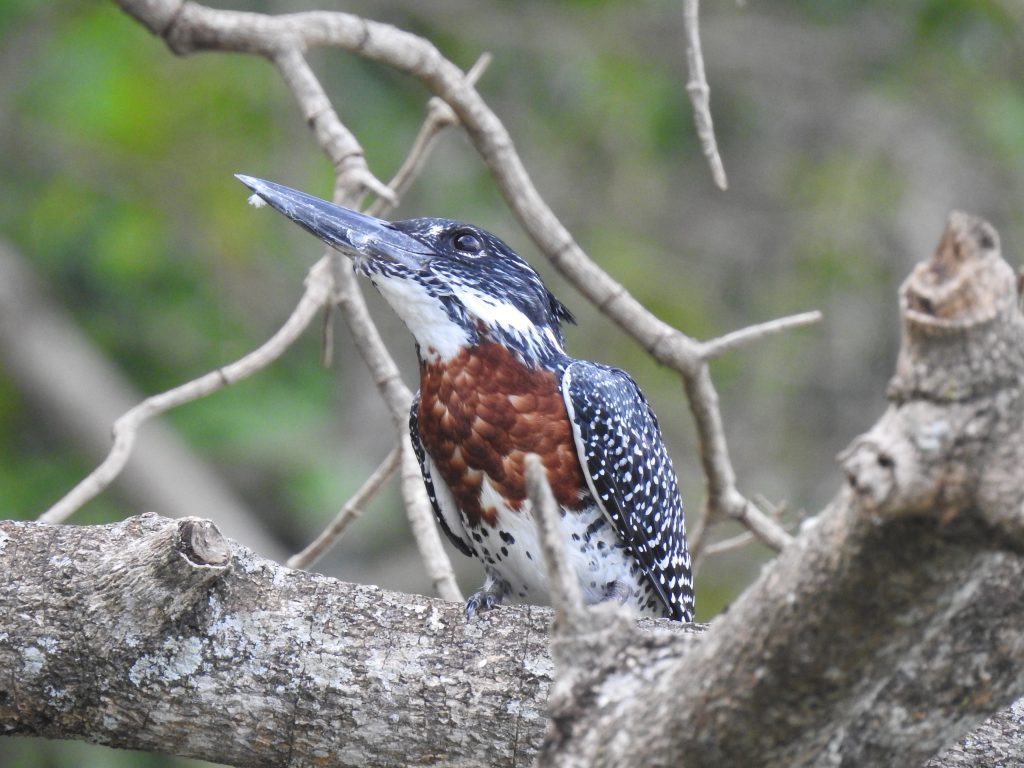
If you ever find yourself standing next to a river in Africa and hear a loud, rattling kek-kek-kek that sounds like a warning alarm, freeze. You’ve just entered the territory of the Male Giant Kingfisher, Africa’s largest kingfisher and one of the most fearless birds on the water.
Don’t let the word “kingfisher” fool you into thinking this is a cute, quiet bird. The male Giant Kingfisher is a feathered warrior. Here are four reasons why this bird is the true boss of the waterways.
1. He Never Stops Talking (And It’s Loud)
Forget a pretty song. The male Giant Kingfisher uses a harsh, cackling keririririri to tell everyone to back off. Whether a human, a predator, or another kingfisher crosses his boundary, he flies alongside the watercourse screaming until the intruder leaves. It’s his version of a security siren.
2. He’s a Featherweight Boxer
When words aren’t enough, he gets physical. If a rival male shows up, the Giant Kingfisher will erect his shaggy crest and bob his body up and down like a boxer psyching himself up. Then? He launches an aerial chase to push the enemy out of his fishing spot. He does not tolerate guests!
3. He’s a Family Builder (With a Tunnel)
These birds mate for life. The male and his partner defend their territory together and dig massive nesting tunnels into riverbanks some up to 2.5 meters (8 feet) long! Imagine digging a tunnel longer than a car using only your beak. That’s teamwork.
4. Tough Love Dad
Here is where it gets interesting. After the chicks leave the nest, Dad feeds them for only one month. Then, he stops cold turkey. Why? He is forcing the teenagers to leave home and find their own territory. It seems harsh, but it keeps the species strong.
Birder’s Secret: How to tell the boys from the girls?
Next time you spot one, look at its belly:
- The Male has a rusty chest band.
- The Female has a rusty belly.
Ready to go tracking?
If you are birdwatching in East Africa, keep your ears open for that rattle call around Lake Duluti.
Happy birding, and watch your boundaries